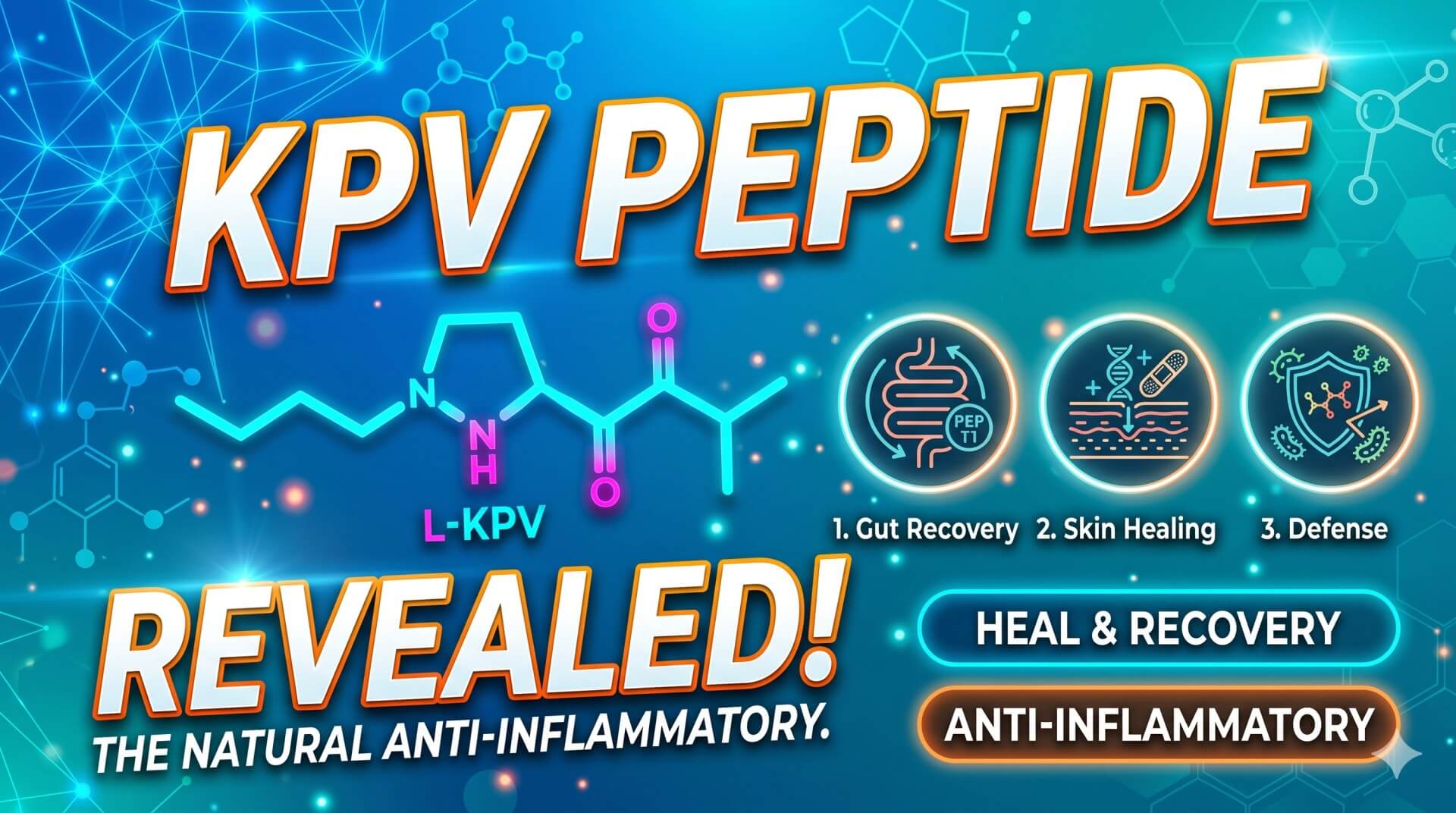
What is kpv peptide?
KPV is a potent, naturally occurring tripeptide consisting of three amino acids: Lysine, Proline, and Valine. It is a fragment of the larger $\alpha$-Melanocyte-Stimulating Hormone ($\alpha$-MSH), a hormone responsible for skin pigmentation and regulating the immune system.
While it is derived from $\alpha$-MSH, KPV does not cause skin darkening. Instead, it isolates the hormone’s powerful anti-inflammatory and antimicrobial properties.
You can buy our lab tested and 3rd party verified KPV peptides, Shipping avaliable all over US
How It Works
KPV functions primarily by entering the cell nucleus and interacting with signaling pathways. Its most significant mechanism is the inhibition of NF-$\kappa$B, a protein complex that acts as a “master switch” for inflammation. By blocking this switch, KPV prevents the body from overproducing pro-inflammatory cytokines.
Primary Research Areas
-
Gastrointestinal Health: It is widely studied for its ability to treat inflammatory bowel diseases (IBD) and “leaky gut” by strengthening the intestinal lining.
-
Dermatology: Due to its anti-inflammatory nature, it is used in topical research for psoriasis, eczema, and acne, often reducing redness and accelerating wound healing.
-
Antimicrobial Action: KPV has demonstrated the ability to combat specific pathogens, including Staphylococcus aureus and the fungus Candida albicans.
Why It’s Unique
Unlike many other peptides that require injection to be effective, KPV is highly stable and can be absorbed effectively through the gut via the PepT1 transporter. This makes it one of the few peptides that is highly bioavailable in an oral form, though it is also researched in topical and injectable versions.
Quick Stats:
-
Sequence: Lys-Pro-Val
-
Natural Source: C-terminal fragment of $\alpha$-MSH
-
Primary Benefit: Non-steroidal inflammation reduction
Kpv Dosage?
Standard research dosages for KPV vary significantly based on the delivery method and the specific condition being addressed. Because KPV is a peptide fragment, it is generally measured in milligrams (mg) or micrograms (mcg).
Common Research Dosages
-
Oral (Capsules): For gut-related issues like IBD or systemic inflammation, the most common research dosage is 250 mcg to 500 mcg, taken twice daily. Some protocols utilize a standard 15 mg strength for more intensive laboratory studies.
-
Injectable (Subcutaneous): For systemic relief, dosages typically range from 200 mcg to 500 mcg per day. This is often administered as a single daily injection.
-
Topical (Creams/Gels): For skin conditions like psoriasis or eczema, KPV is usually applied 2 to 3 times daily. The concentration is typically around 0.5% to 1% KPV by volume.
Key Considerations
-
Cycle Length: Research cycles typically last between 4 to 8 weeks, followed by a break to assess systemic inflammation levels.
-
Bioavailability: KPV is unique because it is highly stable in the gut. While many peptides must be injected to survive stomach acid, KPV utilizes the PepT1 transporter, making oral administration nearly as effective as injection for GI-specific issues.
-
Safety Profile: KPV is generally considered to have a high safety ceiling since it is a naturally occurring tripeptide; however, starting at the lower end of the dosage range is standard practice to monitor tolerance.
kpv peptide benefits!
KPV (Lysine-Proline-Valine) is a potent tripeptide derived from the C-terminal fragment of the alpha-Melanocyte-Stimulating Hormone ($\alpha$-MSH). It is highly regarded in the research community for its ability to modulate the immune system and reduce inflammation without the broad immunosuppressive side effects often associated with traditional steroids.
Here is a breakdown of the primary benefits and mechanisms associated with KPV.
1. Potent Anti-Inflammatory Action
KPV’s standout feature is its ability to inhibit the NF-$\kappa$B pathway, a major signaling “switch” that triggers the production of pro-inflammatory cytokines like TNF-$\alpha$, IL-6, and IL-1$\beta$.
-
Targeted Relief: Unlike many drugs that mask symptoms, KPV enters the cell nucleus to prevent the inflammatory response at its source.
-
Systemic & Local: It can be used to address systemic chronic inflammation or localized issues depending on how it is administered.
2. Gut Health & Digestive Support
KPV is frequently studied for its effects on the gastrointestinal tract, specifically regarding Leaky Gut and Inflammatory Bowel Disease (IBD).
-
Intestinal Lining: It helps strengthen the intestinal barrier, reducing the permeability that leads to “leaky gut.”
-
Colitis & Crohn’s: Research indicates that KPV can significantly downregulate inflammation in the colon, potentially reducing flare-ups in conditions like ulcerative colitis.
-
Absorption: In the gut, it is transported via the PepT1 transporter, allowing it to be effective when taken orally.
3. Dermatological & Wound Healing
Because of its origins in $\alpha$-MSH (which interacts with melanocortin receptors in the skin), KPV is highly effective for skin repair.
-
Psoriasis & Eczema: Topical KPV helps reduce the redness, itching, and scaling associated with these autoimmune skin conditions.
-
Scar Reduction: It modulates collagen metabolism, which can lead to smaller, less prominent scars and prevent the formation of keloids.
-
Accelerated Repair: It speeds up the migration of skin cells to wound sites, facilitating faster closure of cuts or burns.
4. Antimicrobial & Antifungal Properties
KPV has shown “two-in-one” utility by acting as an antimicrobial agent while simultaneously cooling inflammation.
-
Pathogen Defense: It has demonstrated the ability to inhibit the growth of Staphylococcus aureus (bacteria) and Candida albicans (fungus).
-
Infection Control: This makes it particularly useful for treating infected wounds or skin conditions where microbes are preventing proper healing.
What is kpv peptide used for?
KPV peptide is primarily used as a biologically active anti-inflammatory agent. Because it is a fragment of the $\alpha$-melanocyte-stimulating hormone ($\alpha$-MSH), it mimics the hormone’s ability to cool down the immune system without affecting skin pigmentation.
Its applications generally fall into three major categories:
1. Gastrointestinal Recovery
KPV is a popular choice for treating Inflammatory Bowel Disease (IBD), Ulcerative Colitis, and Crohn’s disease.
-
Mechanism: It targets the PepT1 transporter in the gut to reduce the production of pro-inflammatory cytokines.
-
Benefit: It helps “seal” the gut lining and reduces the localized swelling that causes digestive distress.
2. Dermatological Repair
In research and clinical skincare, KPV is used to manage chronic skin conditions and accelerate healing.
-
Conditions: It is effective against Psoriasis, Eczema, and severe Acne.
-
Wound Healing: It speeds up the migration of skin cells to a wound site and modulates collagen production to prevent excessive scarring or keloids.
3. Antimicrobial Defense
Unlike many anti-inflammatories (like steroids) which can weaken the body’s defense against infection, KPV actually has antimicrobial properties.
-
It has shown the ability to inhibit the growth of Staphylococcus aureus (bacteria) and Candida albicans (yeast/fungus).
-
This makes it useful for treating wounds or internal imbalances where an infection is present alongside inflammation.